




There’s no one-size-fits-all definition of “ai robot for adults.” Some adults want a robot that helps manage daily routines. Others want something more companion-like—interactive, expressive, and fun. This guide breaks down the most common adult needs and helps you choose the kind of robot you’ll actually enjoy living with.
What does “AI robot for adults” actually mean?
"AI robot for adults” usually points to one of a handful of expectations:
1) Companion + mood-lifter
A robot that interacts, reacts, and becomes part of your space—like a “pet you don’t have to feed.”
2) Home connection
Remote check-ins, interaction, and presence when you’re away—especially for people who travel, live alone, or work long hours.
3) Productivity assistant
Reminders, routines, integrations. Useful, but if the robot isn’t pleasant to be around, you’ll stop using it.
Loona lands best in buckets 1 and 2, with some light “assistant” behaviors layered in through AI-driven interaction.

7 things adults should look for in an AI robot
Most “best robots” lists skip the unglamorous details. Don’t.
1) Expressiveness (this is what makes it stick)
Adults don’t need “cute.” They need believable feedback—motion, timing, reactions—so the robot feels like a presence, not a screen.
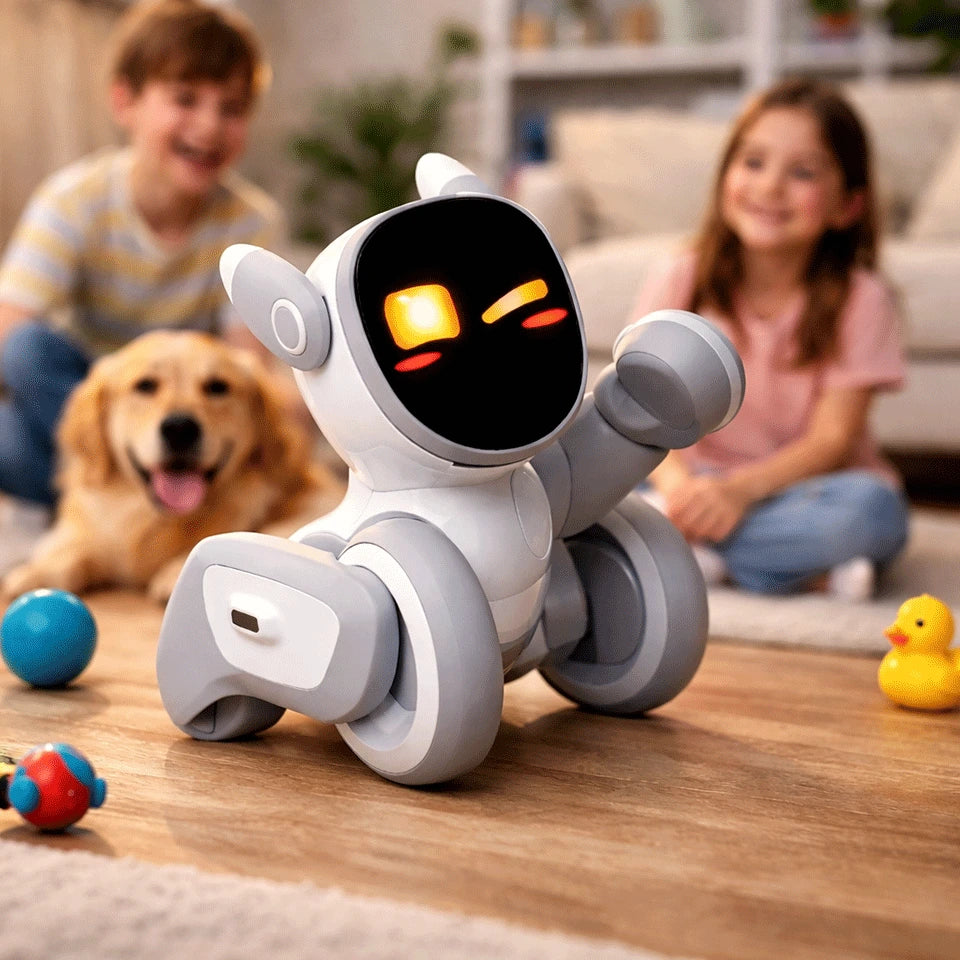
Loona’s product positioning leans hard into expressiveness and emotional-style interaction, which is a big reason people keep it around instead of shelving it.
2) Sensing + navigation (a robot should handle your space)
A robot that can’t perceive distance, obstacles, or motion will feel limited fast.
Loona uses a sensor suite that includes 3D ToF (time-of-flight) plus an RGB camera and inertial sensors (accelerometer/gyroscope) to help it understand where it is and where it can go.
3) Conversation that isn’t “pre-recorded”
A major reason people search “ai robot for adults” is the hope that it can talk like something modern—not like a toy from 2014.
Loona’s materials explicitly mention using ChatGPT for AI interaction / knowledge features.
4) Privacy posture you can actually live with
If a robot has a camera and microphones, you should expect clear information on processing and controls.
Loona’s product page emphasizes that as much data processing as possible is done directly on the device to maximize security and safety.
5) Recharge behavior (because adults don’t “babysit” devices)
A robot that dies mid-interaction and stays dead is basically a paperweight.
Loona is described as having about 2 hours of continuous playtime and returning to its dock to recharge automatically.
6) A “day-2” experience (not just a day-1 demo)
You want variety: games, routines, little surprises.
Loona includes app-enabled games, AR-style pet feeding, and even kid-friendly programming via Google Blockly (yes, adults can enjoy this too—especially if you like tinkering).
7) Hardware that’s not underpowered
If it’s doing perception and interactive behavior, you want decent compute on board.
Loona’s listed specs include a quad-core Cortex A53 CPU and a 5 TOPS BPU, plus onboard RAM/ROM details.
Best AI robot for adults overall: Loona
If you want an AI robot for adults that feels like a companion—something that adds warmth, humor, and presence to your home—Loona is the easiest recommendation.
It’s not trying to be an industrial helper or a humanoid concierge. It’s a “petbot” built for interaction: expressive motion, playful activities, modern AI conversation, and enough sensing to move with confidence in a home environment.
Who Loona is best for
-
WFH adults who want a desk-side companion that breaks up the day
-
People who want “pet energy” without pet logistics
-
Tech-curious adults who enjoy experimenting with interactions and behaviors
-
Anyone who likes the idea of an AI companion robot but doesn’t want something uncanny or overly human
Who should skip it
-
If you want a robot primarily for chores (vacuuming, lawn mowing, pool cleaning), you’re shopping in a different category
-
If you want a robot to be “invisible” and silent—Loona is designed to be interactive and present
What Loona can do
Loona's main features include:
-
Facial recognition (recognizes family members)
-
ChatGPT-powered AI interactions (“source of knowledge” positioning)
-
On-device processing emphasis for security/safety
-
App-enabled games, playful activities, and Blockly programming
-
Auto docking / recharge and ~2 hours continuous playtime
-
Sensors + camera: 3D ToF, 720P RGB camera, 4-mic array, IMU sensors
Notable credibility signals
Loona’s product page lists multiple design/innovation awards (including CES Innovation Awards 2024 and iF Design Awards 2024).
Real adult use cases
Specs are nice, but what really matters is how a robot fits into your day. Here are a few realistic ways adults actually end up using an AI companion robot at home.
1) A better work-from-home day
WFH can get weirdly quiet. Loona shines in the “micro-moments”:
-
a quick interaction between calls
-
a playful interruption when you’re stuck
-
something that makes your space feel less static
And because Loona is designed around expressiveness + interaction, it tends to deliver that “presence” feeling better than devices that are basically a smart speaker with wheels.
2) Low-lift companionship (no feeding, no walking, no guilt)
A real pet is wonderful—and also a responsibility.
Loona is positioned as “all the happiness of having a pet—without all the mess,” which maps neatly onto what many adults actually want after a long day.
3) Staying connected to home
Loona’s materials highlight “peace of mind” and remote monitoring/interactive features. That’s useful if you:
-
travel a lot
-
split time between locations
-
want a sense of presence when you’re away
Setup tips that make Loona feel “alive” fast
Most people judge a robot in the first 48 hours. Here’s how to give it the best shot:
Place the dock like it’s part of your space
Loona is designed to return to the dock for charging, so make docking easy:
-
open area
-
consistent lighting
-
not tucked behind furniture
Give it a “home zone”
Pick a primary room (office or living room). When a robot has a consistent environment, interactions feel more coherent—and you’ll interact more often.
Use it in short, frequent bursts
The goal isn’t marathon sessions. It’s small moments that become routine: 30–90 seconds, a few times a day.
Try one “maker” feature, even if you’re not a coder
Loona mentions Google Blockly programming. Even basic tinkering can turn the robot into your robot, instead of a generic demo.
Conclusion
If you want an AI robot for adults, start with one you’ll actually enjoy living with. The biggest reason people don’t end up loving a home robot isn’t the spec sheet—it’s the vibe. If the robot doesn’t feel responsive, it won’t become part of your day.
Loona checks the boxes that matter for adult-friendly companion robots: modern AI interaction, expressive personality, real sensing/navigation, and practical “live-with-it” behavior like auto-docking. If you choose “ai robot for adults” because you want something that brings presence and play into your home, Loona is the most well-rounded place to start.
FAQs
Is Loona really an “AI robot for adults” if it’s marketed for families/kids?
It can be both. Loona’s product page emphasizes family use, games, and kid-friendly learning—but the underlying value (expressiveness, sensing, modern AI interaction, home presence) is exactly what many adults want from a companion robot.
Does Loona use ChatGPT?
Loona’s official materials explicitly mention “Using Chat GPT” for AI interaction/knowledge features.
How long does Loona run before charging?
The product page states about 2 hours of continuous playtime and that Loona returns to the dock to recharge automatically.
Does Loona have a camera and microphones?
Yes—Loona’s specs list a 720P RGB camera and a 4-microphone array.
What makes Loona different from a smart speaker?
A smart speaker can answer questions. A companion robot needs to move, react, and feel present. Loona’s design focuses on expressiveness, sensing (including 3D ToF), and interactive play behaviors, which is why it tends to feel more like a “companion” than a voice assistant.