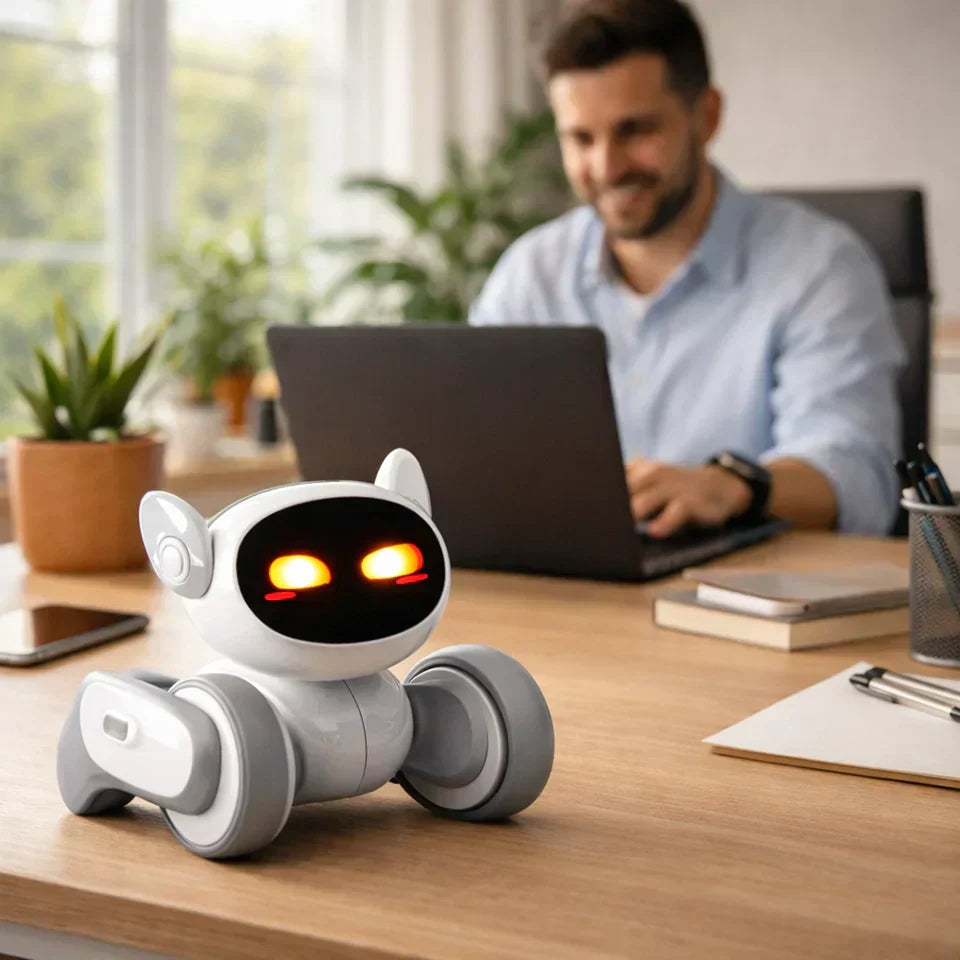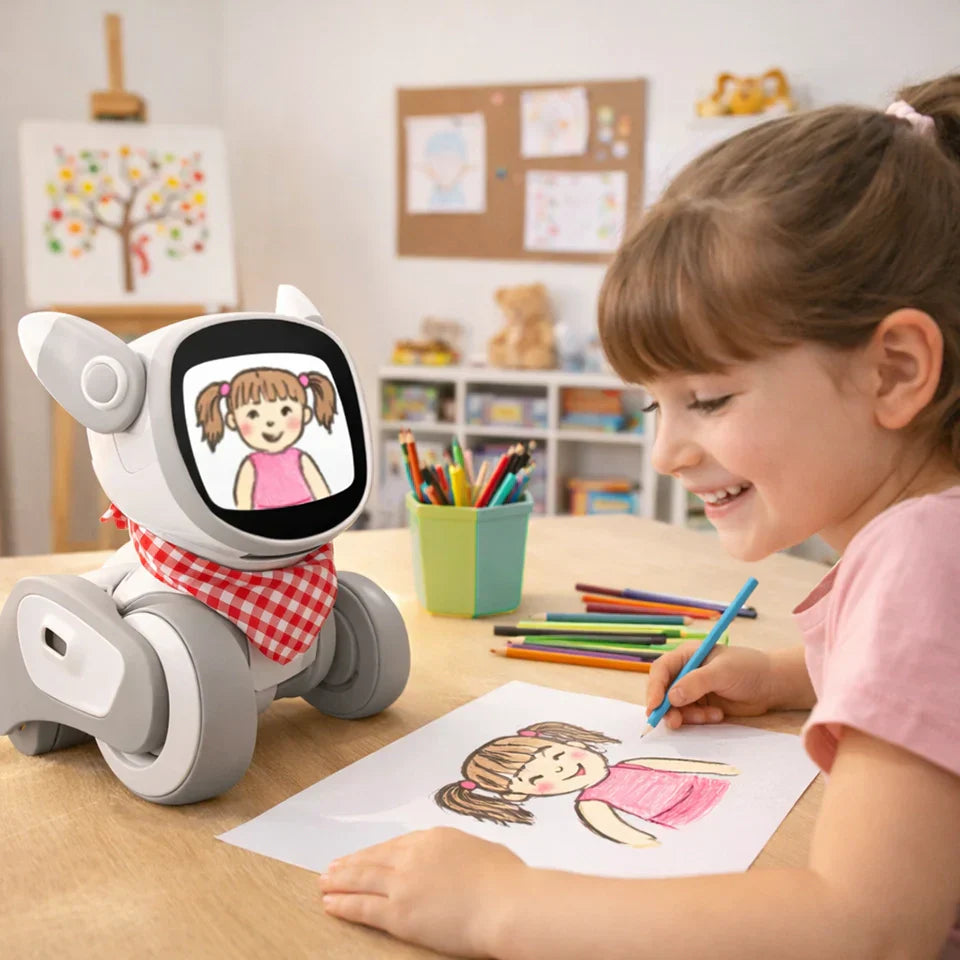






An AI robot doesn’t just repeat a pre-programmed routine. It perceives what’s happening around it, decides what to do next, and adapts its behavior based on inputs like voice, faces, gestures, obstacles, and context.
In this guide, we’ll break down what “AI robot” really means, how modern AI robots work, where they’re already showing up in real life, and what to look for if you’re thinking about bringing one home. We’ll also use Loona—a small companion robot designed for family life—as a concrete example of what “AI robot” looks like when it’s done well.

What is an AI robot?
An AI robot is a physical machine that uses artificial intelligence to make decisions based on what it senses—rather than following only fixed, pre-scripted steps.
A traditional robot might be great at repeating a task the same way every time (think: a factory arm doing one motion). An AI robot is built to handle real-world messiness: people move, lighting changes, furniture shifts, kids interrupt, pets wander in, and the robot has to cope.
In practice, “AI robot” usually includes some mix of:
-
Perception (camera + sensors + AI to understand what it sees/hears)
-
Interaction (speech, conversation, emotion cues, gestures)
-
Planning (choosing an action: follow you, avoid obstacles, go charge, play a game)
-
Learning/personalization (remembering people, preferences, patterns)
Not every robot labeled “AI” is truly intelligent—but the best ones feel noticeably more aware and more alive.
AI robot vs. robot vs. automation: what’s the difference?
This is where a lot of confusion happens:
-
Automation: “If X happens, do Y.” Great for predictable environments.
-
Robot (non-AI): A physical machine that can move and act—but may still rely on strict rules.
-
AI robot: A robot that uses AI models to interpret inputs, respond naturally, and handle variety.
A fun way to spot the difference: if you change the environment slightly and it “falls apart,” it’s probably more automation than AI.
How an AI robot works
Most AI robots follow a loop that looks like this:
1) Perceive: “What’s going on?”
This might include:
-
Camera vision (recognize objects, people, gestures)
-
Microphones (detect voice commands, locate sound direction)
-
Depth/ToF sensors (understand distance and avoid obstacles)
-
Touch sensors (react when you tap/pet it)
Loona, for example, lists capabilities like face recognition, gesture recognition, body detection, obstacle detection, sound localization, and path planning—all core building blocks of a home-friendly AI robot.
2) Think: “What should I do next?”
This is where AI helps the robot choose an action based on:
-
Your words (“come here,” “play,” “take a picture,” “tell me a story”)
-
Your behavior (are you engaging or walking away?)
-
The environment (is the path clear? battery low?)
-
Safety constraints (don’t bump into things)
3) Act: “Do it smoothly”
The robot turns decisions into movement and behavior:
-
Motors move wheels/legs/ears/head
-
Screen or face shows expressions
-
Speaker responds
-
Navigation avoids obstacles
4) Improve: “Next time, do it better”
This can mean learning you by name, recognizing your routines, or adapting the style of interaction over time.
Loona explicitly describes building memories and becoming more personalized through ongoing interaction.
Types of AI robots you’ll see in the real world
“AI robot” is a huge umbrella. Here are the most common types:
Industrial AI robots
Factory arms and automated systems that use AI for vision inspection, adaptive assembly, and scheduling.
Warehouse and delivery robots (AMRs)
Autonomous mobile robots that navigate dynamically in warehouses, hospitals, and campuses.
Service robots
Robots that greet customers, guide visitors, clean floors, or assist staff.
Home companion robots
Robots built for interaction—conversation, play, emotional presence, and light “helpfulness.”
That last category is where Loona sits: a companion-style AI robot designed to feel like a pet and a playful assistant, with multiple input modes (voice, gesture, facial cues) and home navigation behaviors.
What makes a good home AI robot?
If you’re shopping (or just comparing), here’s what usually matters most in a home setting.
1) Multi-modal interaction (not just voice)
Voice-only robots can feel limiting fast. The best home AI robots respond to:
-
Voice
-
Gestures
-
Faces / expressions
-
Movement in the room
-
Touch
Loona highlights handling voice, gesture, and facial recognition, and even cites high accuracy for recognizing facial expressions and gestures.
2) Navigation that’s confident, not chaotic
Home robots don’t need to map your house like a self-driving car, but they should:
-
Avoid obstacles reliably
-
Move naturally around people
-
Know how to return to charge
Loona includes obstacle detection and path planning, plus reviewers mention it returning to its base when battery is low.
3) Personality that doesn’t get annoying
This is underrated. A robot can be “smart,” but if it’s loud, repetitive, or needy, it ends up on a shelf.
Look for:
-
A range of expressions
-
A calm mode (especially with kids)
-
Behavior that feels responsive—not random
Loona is marketed around expressive personality and emotional intelligence, aiming to create stronger bonds over time.
4) Things to do on day 30 (not just day 1)
The early “wow” fades. What’s left is:
-
games
-
creative tools
-
routines
-
new content/features
-
learning and customization
Loona’s page calls out games (like follow-the-leader), AR feeding experiences, and kid-friendly programming using Google Blockly.
Loona as an AI robot example: what it does well
There are lots of ways to define an AI robot. But it’s easier to understand when you picture what one actually does in a living room.
Based on Loona’s product description and specs, here are the “AI robot” traits it’s leaning into most:
1. It’s designed for interaction first
Loona positions itself as a family companion with:
-
conversational behavior “powered by GPT”
-
“perceives” mode (show it objects/pictures/surroundings)
-
creative features like generating digital artwork from prompts
That matters because in a home setting, the robot’s biggest job isn’t “work.” It’s presence.
2. It uses multiple sensing channels
Loona lists:
-
a 720P RGB camera
-
3D ToF (time-of-flight) sensor
-
touch sensor
-
microphone array
-
motion sensors (accelerometer/gyroscope)
This is the practical stuff that helps a robot avoid feeling like a remote-controlled gadget.
3. It’s built for always-on life
The page highlights “remote monitoring and interactive features” for staying connected, plus general “always connected” positioning.
If you’re thinking of an AI robot as part companion and part “smart presence” in the home, those details matter.
4. It has a clear hardware baseline for responsiveness
Loona’s product page includes performance-oriented claims like “5 trillion calculations per second,” along with CPU/compute references (5 TOPS, etc.).
You don’t need to memorize those numbers—but generally, better on-device capability can mean snappier behavior and fewer awkward pauses.
Conclusion
An AI robot isn’t just a moving gadget—it’s a physical companion that can sense what’s happening, make decisions in real time, and interact in ways that feel natural, whether that’s through voice, gestures, faces, or movement around your home. As the technology matures, the most meaningful difference you’ll notice isn’t a spec on a box—it’s how smoothly the robot fits into everyday life: does it respond reliably, avoid obstacles, stay engaging beyond the first week, and feel pleasant to have around?
That’s why Loona perfectly embodies the true meaning of an "AI robot". It combines multi-modal perception (camera, ToF, microphones, touch), interactive behaviors (voice, gestures, face recognition), and home-friendly movement and planning—while leaning into personality, play, and family use. If your goal is an AI robot that feels more like a lively companion than a scripted toy, Loona represents the direction modern home AI robots are heading: more aware, more responsive, and more personal over time.
FAQ
What does “AI robot” mean in 2026?
It usually means a robot that can perceive its environment (vision/sensors), interact naturally (voice/gesture), and make decisions dynamically (planning), rather than only following fixed scripts.
Are AI robots the same as chatbots?
No. A chatbot is software. An AI robot has a body—sensors, movement, navigation, and physical interaction—so its AI has to deal with the real world.
Can an AI robot work without Wi-Fi?
It depends. Some features may run locally; others may rely on cloud services. Check the product details for which capabilities need an internet connection.
Is Loona an AI robot or a toy?
Loona is designed as a companion-style AI robot: it combines sensing (camera/ToF/mics), interaction (voice/gesture/face recognition), and navigation behaviors.
What should I look for in a kids’ AI robot?
Multi-modal interaction, safe navigation, age-appropriate content, and a “calm mode” (or at least behavior that won’t constantly interrupt).