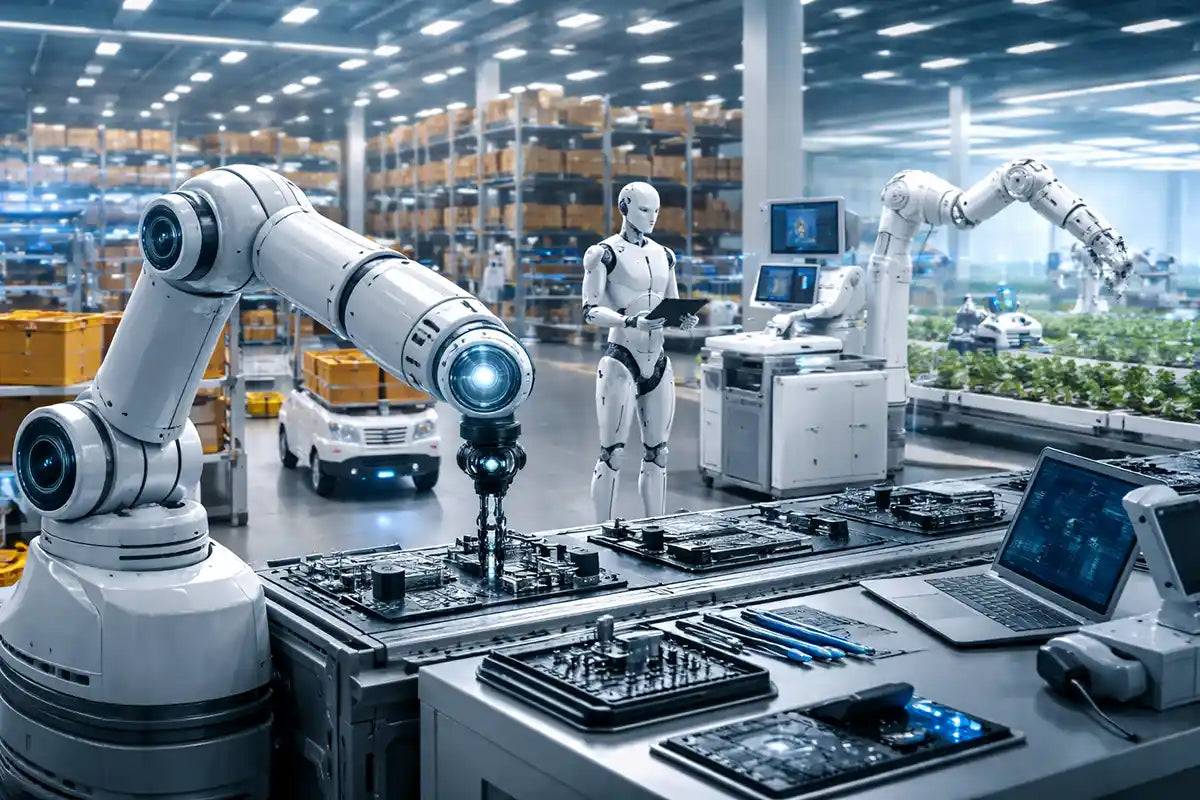






Robots used to be easy to define. They followed fixed instructions, repeated the same motion, and worked best in controlled environments. If the task changed, the robot usually had to be reprogrammed.
That is no longer the full picture.
Today, many robots can identify objects, adjust to new surroundings, optimize their own actions, and even work safely alongside people. The reason is simple: artificial intelligence is changing what robots can do.
So, what is AI in robotics exactly?
In simple terms, AI in robotics is the use of artificial intelligence technologies to make robots smarter, more flexible, and more capable of acting in the real world. Instead of only following rigid rules, AI-powered robots can perceive their environment, make decisions, learn from data, and improve over time.
This shift matters across industries. In manufacturing, AI robots help detect defects and adapt to changing production needs. In logistics, they move goods through warehouses with less human intervention. In healthcare, they support surgery, rehabilitation, and hospital operations. Across the board, AI is pushing robotics beyond repetition and into intelligence.
In this guide, we will break down what AI in robotics means, how it works, the technologies behind it, real-world use cases, major benefits, limitations, and where the field is heading next.
What Is AI in Robotics?
At its core, AI in robotics combines two fields:
-
Robotics, which focuses on machines that can sense, move, and interact with the physical world
-
Artificial intelligence, which enables those machines to interpret information, make decisions, and learn from experience
A robot without AI can still be useful. It may follow a programmed path, repeat a factory task, or perform a simple pick-and-place operation. But its behavior is usually limited to pre-defined instructions.
A robot with AI goes further. It can recognize a package that is slightly out of position, avoid a person walking into its path, choose a better route through a warehouse, or improve its grasping performance after repeated attempts.
That is the real difference: AI gives robots adaptability.
AI in Robotics Definition
A straightforward definition looks like this:
AI in robotics is the application of artificial intelligence methods—such as machine learning, computer vision, and decision-making algorithms—to robotic systems so they can operate with greater autonomy, flexibility, and intelligence.
This definition matters because it highlights something people often miss. AI does not replace robotics. It enhances it.
Robotics provides the body. AI provides more of the brain.
AI in Robotics vs Traditional Robotics
Traditional robots are usually built for structured tasks. They work well when the environment is predictable and the workflow rarely changes. Think of a robotic arm on an assembly line that performs the same weld thousands of times per day.
AI-powered robots are designed for more variability. They are better suited to situations where the robot must interpret data, handle uncertainty, or respond to change.
Here is the difference in practical terms:
| Traditional Robotics | AI Robotics |
| Rule-based behavior | Data-driven behavior |
| Works best in fixed environments | Handles dynamic environments better |
| Repeats pre-programmed actions | Can adapt actions based on input |
| Limited autonomy | Higher autonomy |
| Less flexible when conditions change | More flexible when conditions change |
That does not mean AI robots replace traditional robots in every case. In fact, many industrial systems still rely on conventional automation because it is efficient, stable, and cost-effective. But when tasks become less predictable, AI becomes much more valuable.
AI in Robotics vs Automation
People often use these terms interchangeably, but they are not the same.
Automation refers to systems that perform tasks with limited or reduced human involvement. Many automation systems do not use AI at all. They simply follow fixed rules.
AI robotics is a more advanced form of automation. It applies intelligence to machines operating in the physical world.
For example:
-
A conveyor belt that moves packages on a schedule is automation
-
A warehouse robot that identifies obstacles, chooses routes, and updates its behavior based on traffic patterns is AI in robotics
In other words, all AI robotics supports automation, but not all automation involves AI robotics.

How Does AI in Robotics Work?
To understand how intelligent robots function, it helps to think of them as moving through a loop:
sense → interpret → decide → act → learn
This cycle allows robots to do more than simply execute instructions. It lets them respond to the world around them.
Perception Through Sensors and Vision
Robots first need data about their environment. They gather this through sensors, which may include:
-
Cameras
-
LiDAR
-
Ultrasonic sensors
-
Force and torque sensors
-
GPS
-
Microphones
-
Tactile sensors
These inputs help the robot answer basic but essential questions:
-
Where am I?
-
What is around me?
-
Is there an obstacle nearby?
-
What object am I supposed to pick up?
-
Is the surface safe to move across?
Computer vision plays a major role here. With AI, a robot can identify objects, estimate distances, recognize shapes, read labels, or track human movement. In practical settings, this makes the difference between a robot that only functions in a tightly controlled cell and one that can operate in a changing environment.
Decision-Making and Planning
Once a robot collects data, it has to interpret what that data means and choose an action.
This is where AI-driven decision-making comes in. The system may need to:
-
Plan a route
-
Avoid obstacles
-
Prioritize one task over another
-
Decide how to grasp an item
-
Adjust speed or direction
-
Coordinate with nearby machines or workers
In a warehouse, for example, an autonomous mobile robot may detect congestion in one aisle and take a different path. In manufacturing, a vision-guided robot may notice that a component is slightly misaligned and correct its movement before placing it.
This ability to make context-aware decisions is what makes AI robots more useful in real-world operations.
Learning and Adaptation
One of the most powerful aspects of AI in robotics is that some systems can improve with experience.
This does not always mean the robot is “learning” in a sci-fi sense. More often, it means the system uses data to improve accuracy, efficiency, or reliability over time.
A robot may learn by:
-
Training on labeled data
-
Refining performance through repeated attempts
-
Using simulation before real-world deployment
-
Updating models based on operational feedback
For example, a robotic picking system may become better at identifying and grasping irregular objects after being exposed to more examples. A navigation system may improve route planning after observing traffic flow across a facility.
The result is a system that becomes more capable instead of staying static.
Action, Control, and Feedback Loops
After making a decision, the robot must act in the physical world. This involves motors, actuators, grippers, wheels, arms, or other hardware systems.
But action is only part of the story. Intelligent robotics depends on feedback loops. The robot acts, measures the result, and adjusts if necessary.
That means it can answer questions like:
-
Did I grip the object securely?
-
Did I reach the correct location?
-
Did I deviate from the path?
-
Did something unexpected happen during execution?
This loop is essential because the physical world is messy. Items shift. Floors vary. Lighting changes. Humans move unpredictably. AI helps robots stay effective despite that uncertainty.
Types of AI Robots
AI is used in many different robot categories. The hardware may vary, but the goal is the same: improve intelligence, flexibility, and autonomy.
Industrial Robots
Industrial robots are widely used in manufacturing for tasks like welding, assembly, painting, palletizing, and inspection.
When combined with AI, these robots can become more adaptive. Instead of only repeating fixed routines, they may use vision systems to identify part positions, detect defects, or adjust movements in real time.
Autonomous Mobile Robots
Autonomous mobile robots, often called AMRs, are designed to move through dynamic environments without relying on fixed tracks or external guidance systems.
They are common in:
-
Warehouses
-
Distribution centers
-
Hospitals
-
Manufacturing facilities
AI helps these robots localize themselves, avoid obstacles, optimize routes, and interact more intelligently with busy environments.
Collaborative Robots
Collaborative robots, or cobots, are built to work safely alongside humans.
AI can improve cobots by helping them detect intent, respond to environmental changes, and adjust their actions based on real-time feedback. This makes them useful in flexible manufacturing, packaging, inspection, and light assembly.
Service Robots
Service robots operate in environments like hotels, retail stores, restaurants, airports, and public spaces.
Examples include:
-
Cleaning robots
-
Delivery robots
-
Greeting and information robots
-
Food service assistants
AI enables these systems to navigate public environments, understand basic human requests, and adapt to changing conditions.
Healthcare Robots
Healthcare robotics is growing quickly, and AI is helping expand what these machines can do.
AI in robotics applications include:
-
Surgical support
-
Rehabilitation systems
-
Medication delivery
-
Patient monitoring
-
Hospital logistics
In these settings, intelligence matters because the environment is sensitive, the tasks are varied, and safety is non-negotiable.
Humanoid Robots
Humanoid robots attract a lot of attention because they are designed to operate in spaces built for people.
They are not yet common across daily life, but they are increasingly relevant in research, logistics, and experimental service environments. AI is central to this category because humanoid systems require advanced perception, control, reasoning, and balance.
Real-World Applications of AI in Robotics
AI in robotics is no longer theoretical. It is already changing how businesses operate across multiple sectors.
Manufacturing
Manufacturing remains one of the strongest use cases for intelligent robotics.
AI-powered robots can help with:
-
Quality inspection
-
Adaptive assembly
-
Visual defect detection
-
Predictive maintenance
-
Material handling
Instead of treating every part as identical, AI systems can handle small variations and spot issues earlier. That reduces waste, improves consistency, and helps manufacturers respond to tighter quality demands.
Warehousing and Logistics
This is one of the fastest-growing areas for AI robotics.
In logistics environments, intelligent robots support:
-
Picking and sorting
-
Goods-to-person workflows
-
Autonomous transport
-
Inventory movement
-
Real-time route optimization
Warehouses are rarely as predictable as they look on paper. Congestion, shifting inventory, worker movement, and changing order priorities create constant variation. AI helps robots handle that variation more effectively.
Healthcare
Healthcare robotics benefits from both precision and adaptability.
AI-driven robotic systems may assist with:
-
Surgical guidance
-
Hospital delivery tasks
-
Rehabilitation exercises
-
Lab automation
-
Support for elderly care
Here, the value is not just efficiency. It is also consistency, safety, and the ability to support professionals in high-pressure environments.
Agriculture
Agriculture is becoming more data-driven, and robotics is part of that change.
AI robots in agriculture may help with:
-
Crop monitoring
-
Autonomous harvesting
-
Weed detection
-
Precision spraying
-
Soil and field analysis
Outdoor environments are highly variable, which makes AI especially useful. Lighting changes, terrain differs, and biological systems do not behave like factory components. Robots need to interpret complexity, not just execute routines.
Retail and Hospitality
Retail and hospitality are starting to use AI robotics for customer service and operations support.
Examples include:
-
Shelf-scanning robots
-
Autonomous cleaning robots
-
Food delivery robots
-
Customer guidance systems
These settings require robots to function around people, which makes perception, navigation, and safe interaction especially important.
Autonomous Delivery and Vehicles
AI is central to robots that move through public or semi-public spaces.
This includes:
-
Sidewalk delivery robots
-
Last-mile delivery systems
-
Autonomous forklifts
-
Driverless transport platforms
In these applications, the robot must constantly interpret surroundings and make quick decisions, which is exactly where AI adds value.
Space and Hazardous Environments
Some jobs are too dangerous, remote, or physically demanding for humans. AI robotics is especially useful in these situations.
Examples include:
-
Inspection in hazardous industrial sites
-
Disaster response
-
Bomb disposal support
-
Deep-sea exploration
-
Space missions
These are environments where uncertainty is unavoidable, so intelligent systems are often more useful than rigid automation.
AI Robotics vs Traditional Automation: Which One Is Right for Your Business?
Not every problem needs AI.
In many cases, traditional automation is still the smarter choice. If the task is repetitive, stable, high-volume, and unlikely to change, a rule-based system may deliver faster ROI with less complexity.
Traditional automation is often best when:
-
The environment is tightly controlled
-
The workflow rarely changes
-
The task is simple and repetitive
-
Variation is minimal
-
Predictability matters more than flexibility
AI robotics becomes more compelling when:
-
The environment is dynamic
-
Objects or inputs vary
-
Real-time perception is necessary
-
Human interaction matters
-
The task requires adaptation or decision-making
The best question is not “Should we use AI?”
It is “Where does intelligence create measurable value?”
That shift in thinking helps avoid overengineering and keeps investment grounded in real operational needs.
Conclusion
AI in robotics is changing the role of machines in the real world. Instead of staying limited to repetitive tasks in tightly controlled environments, robots are becoming more aware, more adaptive, and more capable of handling complexity. That shift is already influencing how factories operate, how warehouses move goods, how hospitals manage workflows, and how businesses think about automation at a much larger scale.
The most important thing to understand is this: AI does not just make robots more advanced. It makes them more useful in environments where change is constant.
That is why AI in robotics matters. It is not only about smarter machines. It is about building automation that can actually respond to the real world.
FAQ
What is AI in robotics ?
AI in robotics means giving robots the ability to sense, think, decide, and improve, rather than only follow fixed instructions.
How is AI used in robotics?
AI is used for tasks like vision, navigation, object detection, route planning, speech understanding, quality inspection, and adaptive control.
What is the difference between robotics and artificial intelligence?
Robotics focuses on machines that interact with the physical world. Artificial intelligence focuses on software systems that can interpret information and make decisions. AI in robotics combines both.
What industries use AI robots?
Manufacturing, logistics, healthcare, agriculture, retail, hospitality, transportation, and hazardous-environment operations all use AI robotics in different ways.
What are the biggest benefits of AI in robotics?
The biggest benefits include higher autonomy, improved efficiency, better accuracy, more flexibility, safer operations, and stronger long-term optimization.
What are the main challenges of AI robotics?
Common challenges include cost, complexity, data requirements, safety validation, system integration, and cybersecurity concerns.